
Subtitle: What Nigerian and international research reveals about structured literacy teaching, Igbo-language learning, children’s book clubs and sustainable educational development.
ubtitle: What Nigerian and international research reveals about structured literacy teaching, Igbo-language learning, children’s book clubs and sustainable educational development.
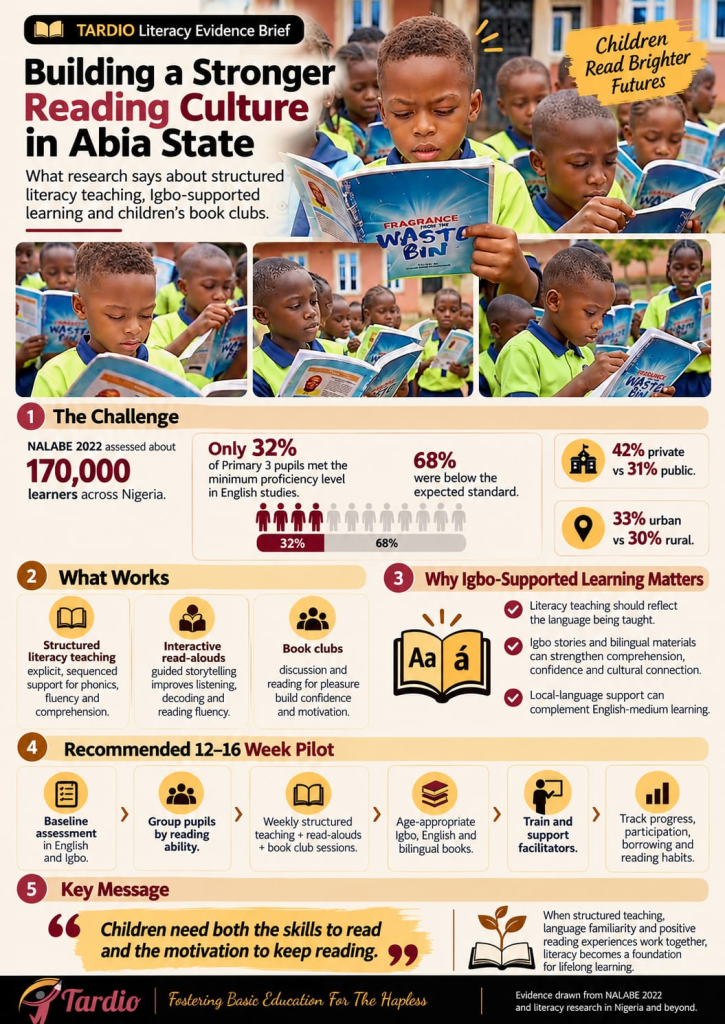
Building a Stronger Reading Culture in Abia State
What Nigerian and international research reveals about structured literacy teaching, Igbo-language learning, children’s book clubs and sustainable educational development.
Helping children become confident readers involves far more than putting books into their hands.
Literacy develops through the interaction of teaching, language, practice, motivation and opportunity. Children must learn how written language works, develop fluency through regular reading and encounter books that reflect their lives, cultures and experiences.
As TARDIO (Tardigrade International Organisation) develops its educational programmes and children’s Book Club initiative in Abia State, Nigeria, educational research offers valuable guidance on how to strengthen literacy outcomes.
Evidence from Nigeria’s national learning assessments, experimental literacy interventions and international studies supports an approach that combines structured reading instruction with meaningful opportunities to read for pleasure.
These approaches should not be viewed as competing alternatives. They address different but complementary aspects of children’s literacy development.
Children need support to learn how to read. They also need positive experiences that encourage them to continue reading.
For TARDIO, therefore, the challenge extends beyond increasing access to books. It involves creating an educational environment in which reading skills, confidence, comprehension and motivation develop together.
Nigeria’s National Learning Assessment Highlights the Scale of the Challenge
Nigeria’s National Assessment of Learning Achievement in Basic Education (NALABE 2022) provides important evidence of the literacy challenges facing the country’s education system.
Conducted by the Universal Basic Education Commission (UBEC) in collaboration with UNICEF, the assessment examined learning outcomes among Primary 3, Primary 5 and Junior Secondary 2 pupils.
The assessment was conducted in 2022, and its comprehensive report was published in December 2025.
According to the NALABE 2022 report published by UNICEF and UBEC, approximately 170,000 learners participated across Nigeria’s 36 states and the Federal Capital Territory. (UNICEF Global)
What the Assessment Revealed
One of the most concerning findings involved the performance of Primary 3 pupils in English studies.
Only 32% of pupils met or exceeded the required minimum proficiency level, while approximately 68% performed below the expected standard.
The assessment also identified differences between school types and locations.
Among Primary 3 pupils:
- 42% of pupils in private schools attained minimum proficiency in English studies, compared with 31% in public schools.
- 33% of pupils in urban schools achieved minimum proficiency, compared with 30% in rural schools.
These figures are drawn from the report’s national analysis of Primary 3 English studies performance. (UNICEF Global)
Importantly, the assessment measured English studies as a subject, including reading comprehension and grammatical accuracy. Its proficiency figures should therefore not be interpreted as a separate national measurement of reading ability alone.
Nevertheless, the findings reveal substantial challenges in children’s foundational language and literacy development.
For organisations supporting basic education, the wider implication is significant.
Providing books and organising occasional reading activities may create opportunities for learning, but children experiencing serious reading difficulties often require structured, sustained support.
Such support must begin with an understanding of what children can already do and the specific skills they have yet to acquire.
The Importance of Reading Resources
The NALABE report also examined factors associated with differences in educational achievement.
Its analysis identified several school resources and conditions associated with stronger learning outcomes. Among these was the presence of libraries in good condition at junior secondary level.
Although this association does not establish that libraries independently cause improvements in learning, it reinforces the value of providing suitable educational resources within supportive learning environments.
For TARDIO, the national findings offer important context. However, national statistics cannot substitute for direct assessment of children in the communities where the organisation operates.
Reading abilities may vary considerably between schools, classrooms and individual pupils.
Establishing a baseline of children’s literacy skills would allow TARDIO to design programmes around demonstrated learning needs rather than assumptions based on national averages.
Structured Literacy Teaching Must Reflect Local Languages
Some of the strongest experimental evidence on early literacy development in Nigeria comes from research examining how children learn to read Hausa.
A study by Emily Koester, Wael Moussa and Mika’ilu Ibrahim, published online in 2025 in the academic journal Reading and Writing, compared alphabetic and syllable-based approaches to early reading instruction.
The researchers conducted a cluster-randomised controlled trial involving 1,708 Grade 1 pupils across 275 schools in northern Nigeria.
The findings demonstrated that the structure of the language being taught can influence which instructional approaches are most effective.
According to the study published by Springer Nature, syllable-based teaching produced measurable improvements in syllable reading and oral reading fluency. It also increased the likelihood that a pupil could read by 13.6 percentage points.
Alphabetic instruction, meanwhile, produced stronger improvements in identifying letter sounds. (Springer Link)
What This Means for Igbo Literacy Development
The significance of this research extends beyond the specific differences between the two instructional approaches.
Its broader contribution lies in demonstrating why literacy teaching should take account of the linguistic characteristics of the language being taught.
Languages differ in their sound systems, syllable patterns, spelling conventions and vocabulary. An instructional method developed for one language may therefore require careful adaptation before being applied to another.
This distinction is particularly relevant to TARDIO’s potential development of Igbo-language literacy resources.
The objective should not be to reproduce teaching methods designed for Hausa, English or other languages without examining their suitability for Igbo.
Instead, reading materials and instructional activities should reflect Igbo’s linguistic structure, orthography, vocabulary and cultural context.
A carefully developed programme could include progressively sequenced reading activities, appropriate vocabulary development, accessible texts and regular opportunities to practise reading.
Collaboration with Igbo language specialists, experienced teachers and literacy practitioners would help ensure that these resources are educationally appropriate and culturally meaningful.
Such an approach could support literacy development in Igbo while complementing children’s English-language education.
The central lesson is that literacy instruction should be adapted to the children and languages it is intended to serve.
Interactive Read-Alouds Offer a Practical, Evidence-Based Strategy
Another Nigerian study provides encouraging evidence about an intervention that could be incorporated into TARDIO’s existing educational activities.
Research by Wael Moussa and Emily Koester, published in Reading Research Quarterly in 2022, examined the effects of teacher-led story read-aloud lessons in northern Nigeria.
The study involved a cluster-randomised trial across 199 schools.
In participating intervention schools, second-grade teachers introduced weekly story read-aloud sessions in addition to their regular curriculum. Teachers in comparison schools continued with the existing curriculum without these additional sessions.
The results were encouraging.
Children who participated in the additional read-aloud lessons demonstrated improvements in several foundational literacy skills, including listening comprehension, letter-sound recognition, decoding and reading fluency.
Reported effects ranged from 0.17 to 0.33 standard deviations.
The researchers also found that increased teacher experience contributed substantially to the effectiveness of the intervention.
Their analysis suggested that additional teaching experience explained between 26% and 51% of the overall read-aloud effect, depending on the literacy skill being measured.
These findings are documented in Moussa and Koester’s study on story read-aloud lessons in Nigeria. (ila.onlinelibrary.wiley.com)
Reading Together Creates Opportunities for Learning
For TARDIO’s Book Club initiative, the implications are practical.
Books become more powerful educational resources when children receive meaningful guidance in how to engage with them.
Interactive read-aloud sessions can introduce unfamiliar vocabulary, model fluent reading and encourage children to think about the meaning of a story.
Facilitators can invite children to predict what might happen next, discuss characters’ decisions, retell events in their own words and relate stories to familiar experiences.
These activities also encourage children to listen, ask questions and express their interpretations.
Reading becomes an opportunity for communication and shared discovery rather than simply an exercise in recognising printed words.
Importantly, the Nigerian research also highlights the value of experienced and well-supported facilitators.
The quality of a reading session depends not only on the story being read but also on the interactions between the adult and the children.
For TARDIO, guided read-aloud activities represent one of the most practical evidence-supported strategies for strengthening its literacy programmes.
Their benefits are likely to be greatest when they complement systematic instruction in the foundational skills children need to become independent readers.
Children’s Book Clubs Can Strengthen Reading Engagement
Children’s book clubs occupy a different but equally valuable place within literacy development.
While structured teaching focuses primarily on building reading skills, book clubs can create opportunities for children to develop confidence, curiosity and enjoyment.
They encourage children to discuss stories, share opinions, explore unfamiliar ideas and discover books that connect with their interests.
The research evidence supporting book clubs is promising, although it remains less extensive than the evidence for structured early literacy instruction.
A study published in February 2026 in The Reading Teacher examined a six-week book-club intervention involving 16 third-grade pupils identified as being at risk academically in a rural Title I school in the United States.
The researchers, Miranda Dickson and Cynthia Baughan, explored changes in reading engagement across behavioural, cognitive, emotional and social dimensions.
The participating children attended small-group book clubs outside normal school hours while continuing to receive other literacy support.
The researchers reported improvements across all four dimensions of reading engagement.
They also noted that all participating pupils met their classroom and state assessment goals.
These findings are presented in the 2026 study, *Empowering Readers: Boosting Reading Engagement for Third Graders With Book Clubs in a Rural Title 1 School*. (ila.onlinelibrary.wiley.com)
Understanding What the Evidence Can—and Cannot—Tell Us
The findings are encouraging, but their limitations matter.
The study involved only 16 pupils, was conducted in a different educational environment and examined book clubs alongside other forms of literacy support.
Its research design therefore does not establish that participation in book clubs independently caused the reported improvements.
Nevertheless, the study highlights an important dimension of literacy development that educational programmes should not overlook.
Reading ability and reading engagement are related, but they are not the same thing.
A child may enjoy stories and participate enthusiastically in discussions while still struggling to read independently.
Another child may become technically proficient at reading without developing a sustained interest in books.
Effective literacy development should address both circumstances.
For TARDIO, this suggests a complementary model in which structured teaching develops reading ability while book clubs encourage curiosity, discussion, confidence and regular engagement with books.
The aim is to help children become readers who are both capable and motivated.
Nigerian Language Policy and the Role of Igbo-Supported Learning
Literacy development in Nigeria must also be considered within the country’s evolving educational policy environment.
In November 2025, the Federal Government announced a significant change to the policy governing languages used for instruction in schools.
The government discontinued the previous mother-tongue-medium instruction policy and reaffirmed English as the official medium of instruction throughout the education system.
The announcement followed discussions at the 69th National Council on Education.
According to the Federal Government’s official statement of 13 November 2025, the decision reflected concerns about implementation challenges, including insufficient indigenous-language learning materials, inadequate teacher preparation, difficulties associated with multilingual classrooms and the transition to English-medium learning. (Federal Ministry of Info)
However, the government also reaffirmed its support for Nigerian languages.
The accompanying Inclusive Language Policy encourages the teaching and learning of at least one Nigerian language alongside English.
Language of Instruction and Language Support
This distinction is important for organisations developing literacy programmes.
The language formally used to deliver classroom instruction is not necessarily the only language that can contribute to a child’s learning experience.
Igbo-language stories, bilingual reading materials and culturally familiar narratives can provide additional opportunities for children to develop vocabulary, comprehension, confidence and an interest in reading.
For children who speak or understand Igbo, such materials can connect reading activities with familiar language and everyday experience.
At the same time, English-language learning can remain central to classroom instruction and curriculum requirements.
For TARDIO, an approach incorporating Igbo stories and bilingual resources could complement English-medium education, provided its implementation is coordinated with participating schools and relevant education authorities.
The policy change should not be interpreted as proof that learning through indigenous languages is educationally ineffective.
Rather, it raises important questions about how language policies can be implemented successfully when schools face limitations in teaching resources, training and institutional support.
Igbo-supported literacy activities offer TARDIO an opportunity to strengthen reading engagement while recognising the cultural and linguistic identities of the children it serves.
Developing an Evidence-Informed Literacy Pilot in Abia State
The research considered in this brief suggests that TARDIO has an opportunity to develop a more structured approach to literacy support.
Rather than treating book distribution, reading clubs and literacy instruction as unrelated activities, these components could become part of a coordinated programme.
A practical next step would be to design a 12–16-week literacy pilot involving selected primary schools in different communities across Abia State.
The pilot should respond to local educational needs while remaining manageable enough for meaningful monitoring and evaluation.
Seven Priorities for the Proposed Pilot
1. Establish children’s existing reading abilities
Participating pupils should undergo appropriate baseline literacy assessments before the programme begins.
Where suitable, assessments could examine relevant reading skills in both English and Igbo.
This would help identify children who require additional foundational support and those ready for more advanced reading activities.
2. Provide structured literacy instruction
Children should receive systematic support appropriate to their current reading levels.
Activities could address sound recognition, decoding, vocabulary, fluency and comprehension, depending on identified learning needs.
Instruction should follow a clear sequence rather than relying exclusively on occasional reading exercises.
3. Introduce interactive read-aloud sessions
Trained facilitators could organise regular storytelling sessions that encourage active listening, discussion and comprehension.
Children should be encouraged to ask questions, predict events, discuss characters and explain what they understand.
These sessions would complement, rather than replace, explicit instruction in reading skills.
4. Strengthen children’s book clubs
Book-club activities should create welcoming environments in which children can enjoy stories and participate without unnecessary pressure.
Reading discussions, storytelling activities and opportunities to recommend books to friends could help cultivate positive reading habits.
Children should encounter books appropriate to their reading abilities, interests and experiences.
5. Develop culturally relevant reading materials
The programme should include age-appropriate English, Igbo and bilingual resources wherever suitable materials are available.
Stories reflecting local communities, familiar experiences and Nigerian cultural traditions could help children connect with reading.
Materials should be reviewed for linguistic accuracy, educational suitability and age appropriateness.
6. Train and support facilitators
Teachers, volunteers and reading-club facilitators would need practical guidance on delivering literacy activities effectively.
Training should include interactive storytelling, basic reading assessment, support for children with different learning needs and constructive approaches to encouraging participation.
Ongoing mentoring and feedback would help maintain programme quality.
7. Measure learning, engagement and programme costs
Monitoring should examine more than attendance or the number of books distributed.
Useful indicators could include reading progress, participation, book borrowing, reading frequency, children’s attitudes towards books and the costs associated with delivering activities.
Where feasible, an appropriate comparison group should be included to strengthen evaluation.
Independent educational expertise could help TARDIO select suitable assessment tools, interpret findings and determine whether observed changes can reasonably be attributed to the intervention.
Learning Before Expanding
The purpose of the proposed pilot should not be to demonstrate success at all costs.
It should be to generate reliable information about children’s needs, programme delivery and the conditions under which different activities produce useful outcomes.
Some approaches may work particularly well for beginning readers. Others may be more effective for children who already possess basic reading skills but require greater motivation and practice.
Understanding these differences would help TARDIO refine its educational interventions before considering expansion.
A successful pilot should therefore be judged not simply by the activities completed, but by what the organisation learns about improving children’s literacy.
Building Literacy Programmes Around Children’s Real Needs
The strongest message emerging from the research is that literacy development requires attention to several connected aspects of learning.
Structured instruction helps children acquire the skills required to recognise words, develop fluency and understand increasingly complex texts.
Linguistically and culturally relevant materials can make reading more accessible and meaningful.
Book clubs and shared reading activities can encourage the curiosity and enjoyment that motivate children to continue practising.
Access to suitable books creates opportunities for reading, while effective facilitation helps children make use of those opportunities.
These elements serve different purposes, but they can reinforce one another.
For TARDIO, this means approaching literacy as a connected system of support rather than a single educational activity.
The organisation’s programmes can be designed to recognise that children do not all begin at the same level, learn at the same pace or respond to the same reading experiences.
A child struggling to recognise letters may require a different form of support from one who can read independently but rarely chooses to do so.
Both children deserve opportunities to progress.
Meaningful literacy development begins when programmes are designed around these differences rather than assuming that one activity will meet every child’s needs.
From Educational Support to Sustainable Literacy Development
TARDIO’s existing commitment to basic education addresses practical barriers that can prevent disadvantaged children from participating fully in learning.
Providing exercise books, textbooks, writing materials and other educational resources remains an important contribution, particularly in communities where financial limitations affect access to learning materials.
The organisation’s educational activities and Book Club initiative also offer a foundation upon which more structured literacy programmes could be developed.
However, access to learning resources represents only one part of the challenge.
Long-term literacy development depends on children’s ability to use those resources effectively, receive appropriate instruction and practise reading regularly.
It also depends on whether reading becomes a meaningful and enjoyable part of their lives.
By combining material support with structured instruction, guided reading activities, facilitator development and ongoing assessment, TARDIO can work towards programmes that are both engaging and measurable.
Over time, evidence generated through its activities in Abia State could inform programme improvements, guide the allocation of limited resources and support partnerships with schools, educators and community organisations.
The organisation would also be better positioned to understand which activities offer the greatest educational value relative to their costs.
This would help transform individual acts of educational assistance into a more sustainable model of literacy development.
The objective is not merely to organise additional reading activities.
It is to help children acquire the skills, confidence and motivation to continue learning beyond the duration of any individual programme.
Conclusion: Helping Children Learn to Read and Keep Reading
Taken together, the research provides a valuable direction for literacy development in Abia State.
Nigeria’s national learning assessment demonstrates the scale of existing educational challenges.
Experimental studies provide evidence that structured literacy instruction and guided story read-alouds can improve important foundational reading skills.
Emerging research on children’s book clubs suggests that enjoyable, participatory reading experiences can strengthen engagement, although further investigation is needed to establish their independent effects on literacy achievement.
The most promising direction for TARDIO is therefore not to choose between teaching children how to read and encouraging them to enjoy reading.
It is to recognise that both objectives matter.
Children need systematic teaching, meaningful opportunities to practise and reading materials that connect with their language, culture and experiences.
They also need encouragement, patient guidance and environments in which reading feels rewarding.
For TARDIO, translating these insights into practical programmes will require thoughtful planning, collaboration with educators and a willingness to learn from evidence gathered within the communities it serves.
Language familiarity can make reading feel accessible. Structured teaching helps children acquire essential skills. Positive reading experiences encourage them to continue.
When these elements work together, literacy becomes more than an educational outcome.
It becomes a foundation for lifelong learning.
The true measure of a reading programme is not simply how many books children receive, but whether they develop the ability, confidence and desire to keep reading.
For TARDIO, building a stronger reading culture in Abia State means creating opportunities for children not only to discover books, but also to develop the skills and motivation to benefit from them throughout their lives.
TARDIO – Tardigrade International Organisation
Fostering Basic Education for the Helpless.


Published by